Venue Ad Budgeting in Cyprus: How to Estimate Costs for Banners, Flyers, Brochures, and Renderings
Venue ad budgets rarely explode because somebody ordered “too much design.” They usually explode because the scope was blurry, the files were not ready, or one brochure quietly turned into a banner, a rendering, a rush job, and three rounds of “one tiny tweak” that was not tiny at all.
If you are planning a venue campaign in Cyprus, the same practical questions show up fast: what belongs in the budget besides printing, what changes the price of a banner versus a brochure, how do renderings fit into the total, and how much does timing affect the final number? Those are good questions. Budgets behave better when they are treated like a checklist with math, not a guessing game with hope.
This guide is a plain-language budgeting map for banners, flyers, brochures, business cards, floor plans, renderings, and a light radio line item. It does not pretend there is one magic Cyprus rate card hiding behind a curtain like a dramatic wizard of laminates. Instead, it explains what usually drives cost, what choices increase or reduce scope, and what to send before you ask for a quote. For a broader view of the studio’s work, the home page, Services, and Portfolio pages show the kinds of venue advertising projects this article is built around.
By the end, you will have a working mental model for estimating your own project, a sample worksheet you can copy into a spreadsheet, a better sense of which decisions deserve early approval, and a cleaner request you can send through the Contact page when you want a project scoped properly.

What “budget” really means in venue advertising
A venue advertising budget is usually four budgets wearing one trench coat. People often ask for “the print cost,” but the actual spend is usually a mix of creative work, production setup, manufacturing, and coordination. If only one of those lines gets counted, the total arrives later with the energy of an uninvited cousin who still expects dinner.
| Budget layer | What it covers | What clients often forget |
|---|---|---|
| Creative | Concepts, layout, copy shaping, adaptation, and revisions | Multiple versions, bilingual copy, and extra concept routes |
| Production prep | File setup, bleed, resizing, proofing, press-ready exports, and supplier coordination | Artwork cleanup and print-specific adjustments |
| Output | Printing, finishing, material choice, stock, mounting, or recording | Finishes, heavier stock, installation hardware, and reprints |
| Delivery | Rush handling, version handoff, transport, or installation timing | Compressed approval windows and late changes |
That is why two campaigns that both “need a banner and some flyers” can land in very different budget ranges. One client has final copy, confirmed dimensions, approved photos, and one venue. Another has three venues, two language versions, uncertain measurements, and a banner that may become mesh after a site visit. Same nouns. Very different workload.
Terminology that makes quote conversations less chaotic
A few terms do a lot of heavy lifting in project estimates:
- Concept: a distinct creative direction, not a small variation of the same layout.
- Adaptation: resizing or reworking an approved design for another format, such as turning a flyer look into a brochure cover or standee.
- Proof: the review version used to confirm content, layout, and technical setup before production.
- Bleed: extra image area beyond the final trim edge so nothing awkward gets clipped. Adobe’s overview of printer’s marks and bleed is a solid reference if the term sounds suspiciously technical.
- Render / rendering: a visualized preview of a venue, zone, or display concept, often used for approvals or presentations.
- Floor plan: the layout drawing that shows placement, paths, and structure; the floor plan reference is useful when stakeholders need a quick shared definition.
When these terms are clear, the estimate gets clearer too. If they are muddy, the quote starts answering a different question than the one you meant to ask.
Cost drivers by deliverable
This is the practical center of the whole exercise. Each format has its own cost logic, and the design fee and output fee should be treated as related but separate lines.
Banners: design is one line, print is another
Banners are deceptively simple. They look like one large rectangle living its best life, but the quote usually depends on two separate decisions: how much creative work the banner needs, and what physical production method the final size and location require.
Design cost usually moves with:
- how many concepts need to be explored
- whether the banner is a fresh design or an adaptation of approved campaign artwork
- how much copy has to fit and whether the message hierarchy is already decided
- whether photos, logos, sponsor marks, or maps still need cleaning and placement
Production cost usually moves with:
- final size and orientation
- material choice such as vinyl, mesh, or fabric
- indoor versus outdoor use
- finishing details such as hems, eyelets, sleeves, or mounting needs
- quantity, because one banner and ten matching banners do not flow through the same setup
If your banner will be mounted in a windy or high-exposure area, material choice is not decorative trivia. It affects cost because it changes both substrate and finishing requirements. The article on banner materials and placement is useful when that decision is still open.
Flyers: quantity matters, but paper and finish still vote
Flyers are where people often underestimate print variables. Design may be straightforward if the message is short and the campaign style already exists, but print cost changes quickly once paper weight, coating, and quantity enter the room like three opinionated uncles at a wedding.
Expect flyer quotes to move with:
- single-sided versus double-sided layout
- final size and whether it follows standard paper formats
- quantity and batching efficiency
- paper stock thickness and feel
- matte, gloss, uncoated, or special finishes
- whether artwork is final or still in active revision
For many campaigns, flyers become economical when the creative is approved once and printed in a planned batch. They become more expensive when copy changes are still happening after the print choice has already been discussed.
Brochures: page count, folds, and content complexity do the heavy lifting
Brochures are where “just print something nice” turns into a small production system. Page count affects both layout time and printing complexity. Fold style affects how information needs to be sequenced. More pages usually mean more content shaping, more image handling, and more approval points. The general brochure reference is useful for explaining the format to non-design stakeholders, especially when fold choices start affecting the structure.
The main brochure cost drivers are:
- page count or panel count
- fold type and how disciplined the content needs to be
- whether copy is already written or still being assembled
- photo quality, retouching, and image sourcing needs
- paper choice, finishing, and binding method where relevant
- how many language versions must be flowed and proofed
A tri-fold brochure with final text and approved images is a different creature from a multi-page venue brochure that still needs content reshaping and a new visual hierarchy. Same category. Different budget logic.
Business cards: small format, surprisingly specific decisions
Business cards are tiny, but they are not free-range chaos. The design may be quick if the brand system already exists, yet the print line still depends on stock weight, finish, quantity, corners, color treatment, and whether the job uses standard digital printing or a more specialized method.
Watch for these variables:
- single name versus multiple staff versions
- standard stock versus premium or textured stock
- single-sided versus double-sided layout
- special finishes or unusual shapes
- whether contact details are final and consistently formatted
The size is small. The approval risk is not. Reprinting a stack because one phone number was wrong is the kind of tiny tragedy that budget worksheets are built to prevent.
Where renderings and floor plans fit in the budget
Renderings sit in a different lane from print production, even when they support the same campaign. They are usually quoted around time, complexity, number of views, and revision depth, not paper stock or quantity.
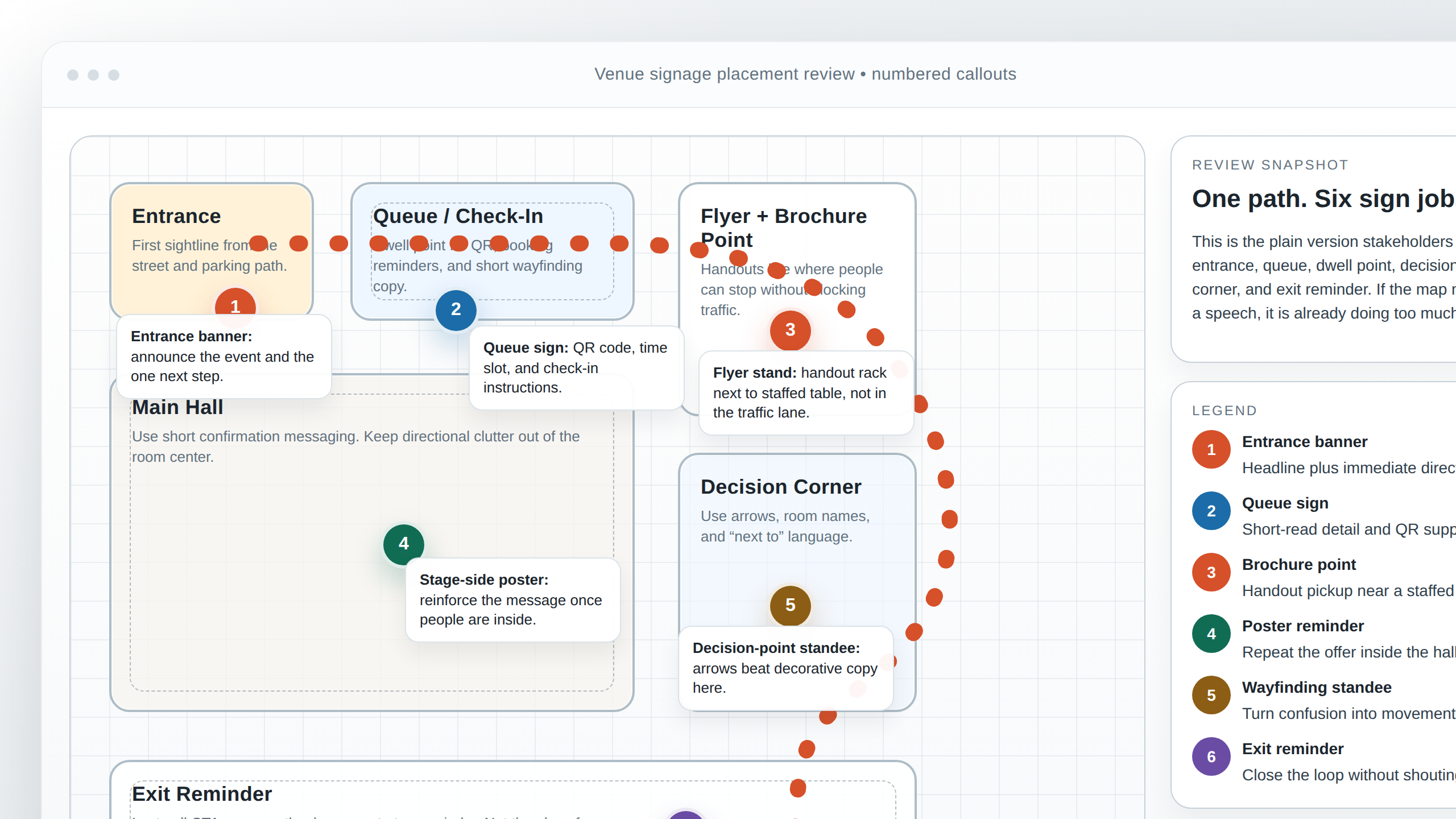
A rendering estimate usually considers:
- how much source material already exists
- whether the work starts from a sketch, a clean plan, or a rough verbal description
- how many camera views or layout versions are needed
- whether the deliverable is technical, presentation-friendly, or both
- how many revision rounds are included before extra time is billed
- how fast the turnaround must be
Floor plans often sit closer to structural clarity. Renderings sit closer to visual communication. Some projects need one. Some need both. A venue team might ask for a plan to confirm where a banner wall goes, then ask for one or two renderings to show stakeholders how the area will feel once branded. That is normal, and it is exactly why those lines should be budgeted separately from the printed deliverables themselves.
If that workflow is still abstract, the existing guide on floor plans and renderings breaks down how those deliverables move from sketch to approval.
Radio as a budget line item: high level, no drama
Radio has different moving parts again. It is less about stock and finishing, more about writing, recording, editing, and delivery. Even when the radio spot is a small supporting asset in a venue campaign, it deserves its own line item rather than being shoved into “miscellaneous” and expected to survive there.
A radio estimate commonly includes:
- script or copy development
- voice-over talent or voice direction
- recording session time
- editing and mixing
- music bed or sound design if required
- delivery versions and file formats
The radio advertisement overview is a quick reference for teams that need a shared baseline for the format. For studio-specific workflow questions, the related article on radio commercial production goes deeper without turning into a microphone-themed fever dream.
Scope choices that quietly change the price
These are the quiet levers. They are not always obvious in the first conversation, but they change time and cost reliably.
| Scope choice | Why it affects budget | Low-friction option |
|---|---|---|
| Number of concepts | Each concept requires separate thinking, layout, and review | Approve one direction early, then adapt it |
| Languages | Text flow, proofreading, and version control multiply | Lock copy before layout starts |
| Photo sourcing | Searching, licensing, and retouching take time | Provide approved images upfront |
| File prep level | Print-ready exports and technical checks add production time | Confirm output specs early |
| Revision rounds | Late structural changes reopen completed work | Separate content edits from polish edits |
| Turnaround speed | Rush work compresses scheduling and approvals | Build approval time into the calendar |
One of the cleanest budget-saving moves is not “pick cheaper paper.” It is “approve the structure earlier.” Scope discipline saves more money than panic trimming at the end.
A simple budget worksheet you can copy
I like to treat venue budgets as a worksheet, not a mood. Once each deliverable has a line, the conversation becomes much calmer.
| Line item | Questions to answer | Example note |
|---|---|---|
| Banner design | New concept or adaptation? How many sizes? | 1 concept, 2 size adaptations |
| Banner production | Size, material, quantity, finishing? | Outdoor mesh, 2 units, eyelets |
| Flyer design | Single or double sided? Final copy ready? | A5, double sided, final text supplied |
| Flyer print | Quantity, stock, finish? | 1,000 units, matte stock |
| Brochure layout | Panels/pages, fold, languages? | Tri-fold, EN + EL versions |
| Rendering / floor plan | How many views? What level of detail? | 1 plan + 2 presentation views |
| Radio spot | Script, voice, edit, delivery versions? | 30-second spot, 2 cutdowns |
| Contingency | What changes are likely after first proof? | Reserve for final copy or quantity change |
If you want a simple formula, start here:
- List each deliverable separately.
- Split creative, production prep, and output into separate columns.
- Add a note for versions, languages, and revision assumptions.
- Mark any line that depends on unconfirmed dimensions, copy, or quantities.
- Leave a small contingency for late-stage changes instead of pretending they cannot happen.
That worksheet will not produce exact vendor rates by itself, and it should not try to. Its job is to turn a vague request into a scope that can be quoted without surprises.
Questions to ask before you approve a quote
This is where budgeting becomes adult and responsible, which is a terrible vibe but a useful one.
- How many concepts are included? Make sure “design” does not hide a mismatch in expectations.
- How many revision rounds are included? Ask what counts as a revision versus a new scope item.
- Are print-ready files included? If yes, confirm what specs they are being prepared for.
- What is excluded? Photo sourcing, copywriting, translation, installation, and rush handling are common examples.
- What does final handoff look like? PDF only, source files, multiple sizes, or supplier-ready exports?
- Who is responsible for final proofing? Someone must own the last check for names, dates, quantities, and contact details.
If the quote feels low but relies on undefined assumptions, it is not necessarily cheaper. It may just be vague with good posture.
Timeline planning: the calendar is part of the budget
Rushed approvals cost money because they compress decisions, not because clocks are rude. When artwork is approved late, print windows shrink, supplier options narrow, and mistakes become harder to catch before output.
A healthier venue timeline often looks like this:
- brief and measurements confirmed first
- concept or structure approved before detailed production prep
- copy locked before multi-format adaptation begins
- proofing window protected instead of treated as optional garnish
- production or recording booked after core approvals, not before them
That sequence reduces rush charges and prevents the classic chain reaction where one late brochure approval delays banners, print delivery, and the supporting signage plan at the same time. The studio’s About page explains the working style behind that kind of structured delivery if you want the broader context.
What to send to get an accurate estimate
This checklist is the budgeting equivalent of cleaning the table before you start cooking. The better the input package, the cleaner the estimate.
- Dimensions: banner sizes, brochure size, flyer format, card size, screen ratios, venue wall or stand measurements.
- Quantities: how many of each printed item you expect to need.
- Copy: final or near-final text, including phone numbers, URLs, offers, dates, and sponsor names.
- Brand assets: logos, fonts if licensed for sharing, color references, and any existing campaign materials.
- Photos: approved images, venue photos, product shots, or sponsor assets at usable quality.
- Locations: where each asset will be used, especially for venue banners and signage.
- Versions: language versions, size variations, or venue-specific adaptations.
- Timing: first draft deadline, approval date, production deadline, and event or launch date.
If even half of that list is missing, the quote will either stay broad on purpose or become more precise later after re-scoping. Neither outcome is scandalous. It is just the boring magic of accurate project planning.
Conclusion: budget the scope, not just the print
The cleanest way to estimate a venue advertising campaign is to stop treating it like a single purchase. It is a set of deliverables with different cost engines: banners depend on size, material, and finishing; flyers depend on quantity, paper, and print handling; brochures depend on structure and content complexity; renderings depend on views, detail, and revisions; radio depends on script, voice, edit, and delivery.
That sounds like more moving parts, because it is. The upside is that once those parts are named, the budget becomes easier to control. You can trim scope intelligently, protect the pieces that matter most, and ask for a quote that answers the real project instead of a simplified version of it.
Key takeaways
- Separate design from production. They behave differently and should be quoted differently.
- Count revisions, versions, and languages early. Those are real scope multipliers.
- Treat renderings and radio as their own lines. They support the campaign, but they do not follow print-cost logic.
- Protect the approval timeline. Rush decisions create rush costs.
- Send better inputs. Dimensions, copy, quantities, and assets are what make estimates accurate.
If you want to try one small experiment before requesting a quote, build the worksheet above first, mark what is confirmed and what is still unknown, and then send that version. It gives everyone less chaos to price.