How to Prepare a Print-and-Approval Brief for Venue Ads in Cyprus
How to Prepare a Print-and-Approval Brief for Venue Ads in Cyprus
If you want fewer revisions and fewer awkward surprises at the print stage, start with a brief that does the boring work first. That is not glamorous. It is, however, cheaper than reprinting a banner because someone discovered the wrong size after the layout was already “final.”
This guide is for venue managers, marketing coordinators, and small businesses preparing banners, flyers, brochures, business cards, and on-site advertising in Cyprus. The goal is simple: give your designer enough information to build the right file, route approvals cleanly, and avoid copy that causes legal or privacy headaches later.
Why a one-page brief saves time
A good brief turns a loose request into a workable production job. It keeps the first round focused on the right size, the right message, and the right placement. That matters even more for venue advertising, where the same campaign may need a banner, flyer, brochure insert, and business card version of the message.
If you need a broader planning reference for your campaign, the current Cyprus government guidance on advertising board structure placement is worth reading before you promise a sign can go anywhere it likes. Boards and structures often involve municipal or community council authorization.
What the brief must answer
Start with the decisions that change design. Not the biography of the business. The business can tell that story later.
- Goal: What is the piece meant to do? Drive bookings, promote an event, direct visitors, announce a launch, or support a permit application?
- Audience: Tourists, local customers, passersby, trade visitors, members, or suppliers?
- Offer or message: One headline promise, one call to action, and any time limit.
- Placement: Indoor, outdoor, window, roadside, reception desk, trade show stand, or handout.
- Deadline: When does the design need approval, and when does print need to happen?
For any job involving a formal application or planning packet, the current Cyprus planning permission guidance is a useful reminder that supporting plans and documents matter. In other words: do not leave the technical pieces for someone to guess.
Print specs designers need before they start
This is where briefs often go vague, and vague is expensive. A designer cannot reliably produce a print-ready file without the technical specs.
| Spec | What to provide | Why it matters |
|---|---|---|
| Final size | Exact finished dimensions in mm or cm | Sets the layout and prevents scaling mistakes |
| Bleed | Extra image area beyond the trim line | Stops white edges after cutting |
| Crop marks | Whether the printer wants them included | Helps the cutter trim accurately |
| Safe area | Space where text and logos must stay inside | Protects important copy from being sliced off |
| File format | Usually print-ready PDF, unless the printer says otherwise | Makes handoff cleaner and easier to review |
| Color mode | CMYK for print, not casual screen-only RGB | Reduces color drift between monitor and press |
Adobe’s current guidance on bleed, slug areas, and printer marks is a solid technical reference for these basics. If you have a flyer or brochure in production, the same logic applies: give the printer a clean file, not a hopeful one.
Adobe also explains how to set print bleed correctly. That matters because the extra margin is not decorative. It is there so the cutting process does not expose unprinted edges.
What to send the designer with the brief
Good briefs are backed by actual assets. The designer should not need to rebuild your business from memory.
- Logo files in usable formats, ideally vector where available
- Approved photos of the venue, products, team, or event
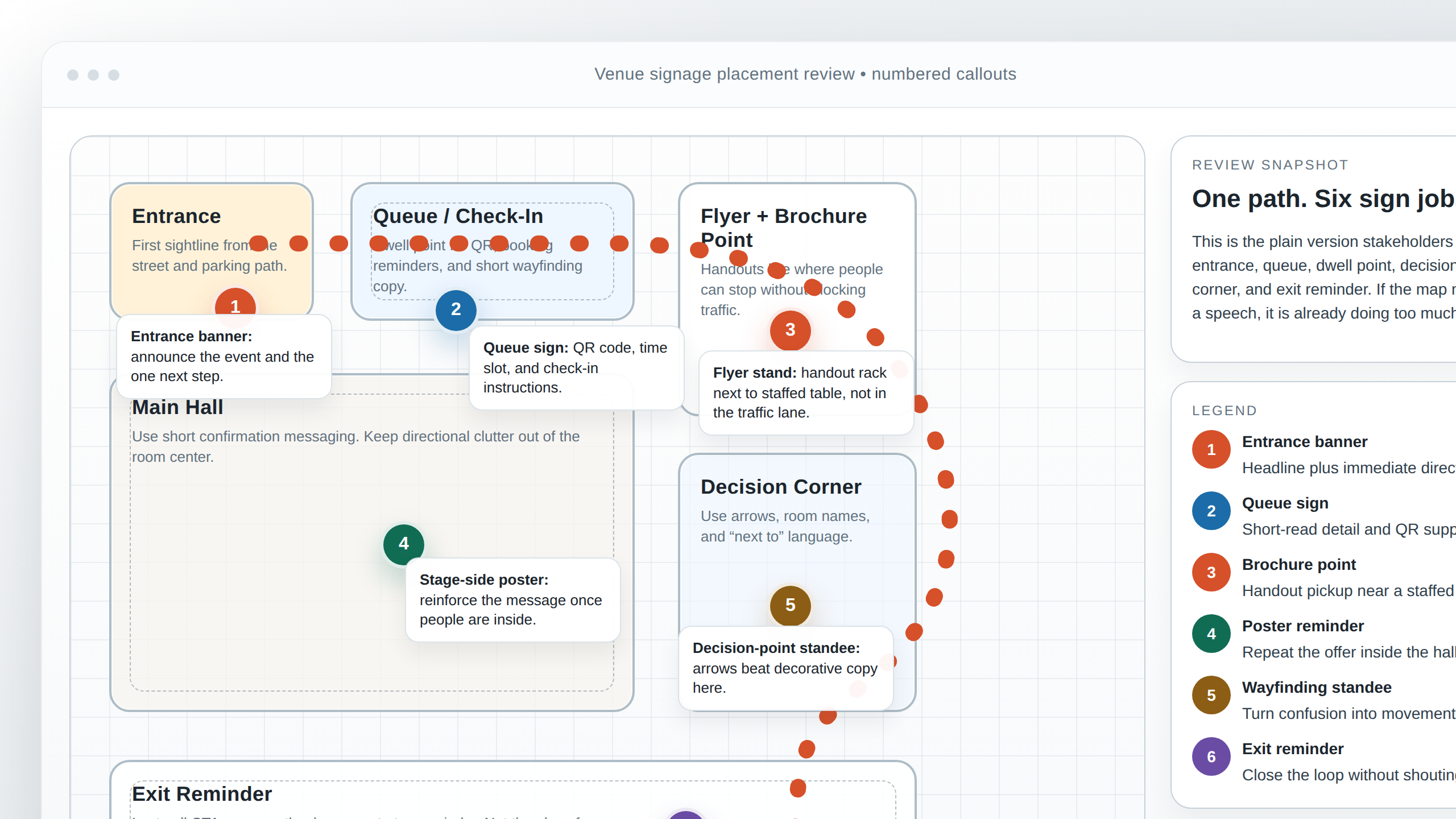
- Floor plans, site sketches, or simple placement diagrams for on-site ads
- Existing brand colors, fonts, and previous materials
- Any legal lines, disclaimers, or terms that must appear
- Examples of styles you like and styles you want to avoid
If the campaign touches email or SMS follow-up, do not assume print promotion gives you permission to message people later. The Cyprus data protection guidance on direct commercial promotion via messages is clear that consent matters for promotional email and SMS. The European Union’s guide to promoting a business while respecting customers says the same thing in broader terms.
Approval workflow: decide who can say yes
Most print delays are not design delays. They are approval delays. Everyone wants to “just check one more thing,” which is business language for “no one owns the decision.”
Before the job begins, name the approver, the backup approver, and the final sign-off point. Then define how many revision rounds are included and what counts as approval.
- Round 1: layout and message direction
- Round 2: copy, dates, prices, and legal lines
- Final proof: spelling, sizes, bleed, contact details, and print specs
Before print release, confirm the following:
- the correct venue name and address are used;
- all phone numbers, emails, and URLs are correct;
- the offer dates are still valid;
- image permissions are cleared;
- the printer has the file format they asked for;
- the sign or board placement has been reviewed where authorization may apply.
Cyprus-specific checks for venue advertising
Cyprus is not the place to assume every outdoor sign, board, or structure can appear by default. If the advertisement is fixed to a building, placed outdoors, or forms part of a structure, check the relevant municipal or community process early. The safest brief is the one that flags the permit question before the artwork gets too polished to change.
That is especially true when the design includes mounting points, dimensions, or site-specific placement. If you need a practical overview of the document trail, the government guidance on advertising board placement in Cyprus is a good starting point for the planning conversation.
For businesses that also need an external website presence, it helps to keep the workflow tidy across channels. A campaign can be simpler when your public pages, contact details, and service description are already organized on the services page and the contact page.
A simple brief template you can copy
Use this as a starting point for banners, brochures, flyers, and business cards.
Project:
Objective:
Target audience:
Placement:
Final size:
Bleed / safe area:
Required copy:
Logo and photo assets:
Brand references:
Approver:
Revision limit:
Print deadline:
Permit / placement check:
Notes for privacy or consent:
If the brief is for a more visual brand story, the portfolio page is the right place to see how finished work can be presented cleanly. If you want to understand the studio behind the process, the about page should do that job without theatrical fog.
Final rule: write the brief for the printer, not for optimism
The best brief is plain, specific, and slightly less exciting than the sales meeting that inspired it. That is a feature. It gives the designer enough information to work quickly, the approver enough structure to decide, and the printer enough detail to produce the job correctly the first time.
If you are ready to turn a rough campaign idea into a usable print plan, start with the brief. Then approve the brief. Then design the thing. Order matters; print shops are allergic to improvisation.
For help with venue ads, print materials, or a structured campaign handoff, use the contact page to request a quote, or review the studio’s recent work before you decide what to build next.